Author: Manish Agarwal

  • The Most Important Decision of Your Life Isn’t Your Career—It’s Choosing the Right Life Partner

    The Most Important Decision of Your Life Isn’t Your Career—It’s Choosing the Right Life Partner

    We spend years preparing for the biggest moments of our lives.

    We obsess over getting into the right college.
    We worry about building the perfect career.
    We work tirelessly to earn more money.
    We dream of owning a beautiful home, buying the perfect car, and achieving financial independence.

    Society tells us these are the milestones that define success.

    But in my opinion, there is one decision that quietly outweighs all of them.

    Choosing the right life partner.

    It is the foundation upon which every other success is built.

    A college degree may shape your knowledge.

    A career may shape your income.

    A business may shape your reputation.

    But the person you choose to share your life with shapes your peace, your purpose, your confidence, your emotional strength, and ultimately, the quality of your entire existence.

    Every Great Achievement Begins at Home

    People often admire successful entrepreneurs, leaders, scientists, artists, and visionaries.

    They study their strategies, their habits, and their work ethic.

    What they rarely see is the environment those people return to every evening.

    Behind many remarkable individuals stands someone who believes in them even when the rest of the world doesn’t.

    A supportive spouse becomes far more than a husband or wife.

    They become your confidant.

    Your advisor.

    Your emotional anchor.

    Your toughest critic.

    Your biggest cheerleader.

    Your safe place after every difficult day.

    Success isn’t built only in offices and boardrooms.

    It is built in kitchens, living rooms, late-night conversations, moments of encouragement, and silent sacrifices.

    The One Person Who Chooses You

    Think about it.

    Your parents didn’t choose you.

    You didn’t choose your siblings.

    You didn’t choose your relatives.

    Your colleagues are assigned by circumstance.

    Your friends often come together through school, work, or shared experiences.

    But your life partner?

    Out of billions of people in the world, they choose you.

    Not because they have to.

    But because they believe in you.

    They place their trust, dreams, and future into your hands.

    And you do the same.

    That decision deserves more thought than almost any other decision you’ll ever make.

    Marriage Is More Than Love

    Love may bring two people together.

    But marriage is sustained by something much deeper.

    Respect.

    Trust.

    Communication.

    Patience.

    Loyalty.

    Shared values.

    Mutual growth.

    Physical attraction fades.

    Money comes and goes.

    Careers change.

    Businesses succeed and fail.

    But when two people genuinely stand beside each other through every season of life, they become stronger than any challenge.

    Your Life Partner Is Your Greatest Business Partner

    People spend months researching before investing in a company.

    They analyse financial statements.

    They study risks.

    They perform due diligence.

    Yet many people choose a spouse based solely on emotions, attraction, or social pressure.

    Ironically, your spouse will influence more financial decisions than any business partner ever will.

    They’ll help decide where you live.

    How you save.

    How you spend.

    How you raise your children.

    How you recover from setbacks.

    How you celebrate success.

    The right partner doesn’t simply share your life.

    They multiply your potential.

    Sometimes the best advice you’ll ever receive won’t come from a consultant or mentor.

    It will come from the person sitting across the dinner table.

    Peace Is an Invisible Asset

    Money can buy comfort.

    It cannot buy peace.

    Titles can earn respect.

    They cannot guarantee happiness.

    Fame attracts attention.

    It doesn’t eliminate loneliness.

    A peaceful home is one of life’s greatest luxuries.

    When your home becomes a place of understanding instead of conflict, your mind becomes clearer.

    Your decisions improve.

    Your confidence grows.

    You become a better leader, parent, entrepreneur, friend, and human being.

    The right life partner doesn’t remove every problem.

    They make every problem easier to face because you’re no longer facing it alone.

    Choose Character Over Charm

    Charm can impress.

    Beauty can attract.

    Success can inspire.

    But character sustains a lifetime.

    Ask yourself:

    Can this person communicate during difficult conversations?

    Can they celebrate your success without jealousy?

    Will they stand beside you when you fail?

    Do they respect your family?

    Can they apologise?

    Can they forgive?

    Can they grow?

    Can they build a life instead of simply dreaming about one?

    These questions matter far more than appearances or social status.

    A Wrong Choice Doesn’t Just Affect You

    Marriage doesn’t impact only two individuals.

    It influences generations.

    Children grow up watching how their parents speak to each other.

    Families are shaped by the emotional climate inside a home.

    Businesses are affected.

    Health is affected.

    Mental peace is affected.

    Every major decision becomes easier—or harder—depending on the strength of your relationship.

    That’s why choosing a life partner isn’t simply a romantic decision.

    It’s one of the most important strategic decisions you’ll ever make.

    Success Means Little Without Someone to Share It With

    Imagine reaching every goal you’ve ever dreamed of.

    A successful business.

    A beautiful house.

    Financial freedom.

    Recognition.

    Now imagine coming home to loneliness, constant conflict, or emotional distance.

    Would it still feel like success?

    True success isn’t measured only by what you’ve built.

    It’s measured by who stands beside you when you’ve built it.

    And even more importantly…

    Who stands beside you when everything you’ve built falls apart.

    Final Thoughts

    The world encourages us to invest in education, careers, property, and wealth.

    All of those things matter.

    But before investing in any of them, invest time in choosing the person who will walk beside you for the rest of your life.

    Choose someone whose values align with yours.

    Someone who brings peace rather than chaos.

    Someone who celebrates your victories without competition.

    Someone who reminds you who you are when life becomes difficult.

    And strive to become that kind of partner in return.

    Because the greatest investment you will ever make isn’t in the stock market, real estate, or your business.

    It’s in the person with whom you choose to build your life.

    Everything else rests upon that foundation.

  • Patience: The Quiet Teacher in the Age of Instant Knowledge

    Patience: The Quiet Teacher in the Age of Instant Knowledge

    Over the past few years, if there is one quality that has quietly reshaped my perspective on life, it is patience. Not just the patience to wait for opportunities or outcomes, but the patience to learn, to observe, and to accept that meaningful understanding can never be rushed.

    We live in an era where information is available at our fingertips. A question can be answered within seconds, a tutorial can be watched in minutes, and endless streams of content compete for our attention every day. While this accessibility is one of the greatest advantages of our time, it has also created an illusion—an illusion that consuming information is the same as acquiring knowledge.

    Perhaps the most visible example of this is the rise of short-form content. A sixty-second reel, a quick social media post, or a simplified infographic can introduce an idea, but it can never replace genuine understanding. Yet, it is increasingly common to see people watch a handful of videos and immediately consider themselves informed enough to debate complex subjects with unwavering confidence.

    The problem isn’t that short-form content exists. In fact, it serves an important purpose. It sparks curiosity, introduces new concepts, and makes learning more accessible than ever before. The problem begins when we mistake these brief introductions for comprehensive knowledge.

    True learning has always demanded something more.

    It demands curiosity that extends beyond the first answer. It requires asking better questions rather than settling for convenient ones. It involves reading books, exploring different perspectives, verifying facts, understanding historical context, and sometimes realizing that what we believed yesterday was incomplete today.

    Knowledge is rarely built in moments; it is built over time.

    The more deeply you study any subject—whether philosophy, science, finance, psychology, history, or even everyday life—the more you discover how much remains unknown. Ironically, genuine expertise often brings humility rather than certainty. Those who truly understand a field are usually the first to acknowledge its complexities, while those with only a surface-level understanding often express the greatest confidence.

    This phenomenon is not new. Throughout history, wisdom has always required patience. Great thinkers did not become knowledgeable because they found shortcuts; they became knowledgeable because they dedicated years, sometimes decades, to observation, study, experimentation, and reflection.

    Patience teaches us something that instant gratification never can: depth matters more than speed.

    In today’s digital culture, we are conditioned to seek quick conclusions. We scroll instead of studying. We react instead of reflecting. We consume opinions faster than we evaluate evidence. As a result, assumptions formed from fragments of information often masquerade as facts. These assumptions may sound convincing, but they rest on foundations that are often incomplete or even inaccurate.

    There is an important distinction between being informed and being educated.

    Being informed means knowing that something exists.

    Being educated means understanding why it exists, how it developed, where its limitations lie, and what perspectives challenge it.

    That difference can only be bridged through patience.

    Patience allows us to resist the temptation of immediate certainty. It encourages us to sit with questions before rushing toward answers. It reminds us that changing our opinion after learning something new is not a weakness but a sign of intellectual growth.

    The greatest learners are rarely the loudest voices in the room. They spend more time listening than speaking. They understand that every subject has layers, and every layer reveals another question waiting to be explored.

    Over the years, I have come to appreciate that wisdom is not measured by how quickly we respond or how confidently we argue. It is measured by our willingness to keep learning, to admit what we don’t know, and to remain patient throughout the process.

    In a world obsessed with speed, patience has become an underrated virtue. Yet it remains one of the most powerful tools for personal growth. It transforms information into understanding, understanding into knowledge, and knowledge into wisdom.

    The next time we encounter a complex topic, perhaps the best response isn’t an immediate opinion. Perhaps it’s a simple acknowledgment that there is more to learn.

    Because real knowledge is never downloaded in a minute—it is earned through curiosity, reflection, consistent effort, and, above all, patience.

  • Book Review: Pines by Blake Crouch

    Book Review: Pines by Blake Crouch

    Some books pull you in with a compelling mystery. Others captivate you with unforgettable characters. Pines manages to do both while constantly making you question everything you think you know.

    The story begins with the disappearance of Secret Service agent Ethan Burke, who wakes up in the seemingly peaceful town of Wayward Pines after a devastating accident. What initially appears to be a simple investigation quickly transforms into something far more unsettling. The deeper Ethan digs, the stranger the town becomes, and every answer he uncovers only leads to even bigger questions.

    One of the novel’s greatest strengths is its pacing. Blake Crouch wastes very little time before immersing readers in an atmosphere of unease. Every interaction feels meaningful, every conversation carries hidden intentions, and every chapter ends with just enough suspense to make it difficult to put the book down. The constant feeling that something isn’t quite right keeps the tension alive from beginning to end.

    Ethan is an engaging protagonist because he refuses to accept the reality placed before him. His determination to escape Wayward Pines and uncover the truth makes him easy to root for. Watching him struggle against forces he doesn’t fully understand creates an emotional connection that goes beyond the central mystery. His resilience, curiosity, and unwillingness to surrender make him the heart of the novel.

    One of the most emotional moments comes when Ethan finally reunites with his wife and son. However, this reunion is far from the happy ending one might expect. Time, circumstances, and the unimaginable reality surrounding Wayward Pines have changed everything. What should have been a moment of complete relief instead becomes another reminder that nothing in this town is ever as straightforward as it seems.

    As the story unfolds, the scope expands far beyond a simple missing-person case. The world Ethan believed he knew is revealed to be vastly different from reality, forcing both him and the reader to reconsider everything that came before. While many mysteries receive satisfying explanations, Blake Crouch intentionally leaves several questions lingering, ensuring that curiosity remains long after the final page.

    Perhaps the most fascinating aspect of the novel is Ethan’s internal conflict. Even after learning the truth, he continues to wrestle with the life he has lost and the one now placed before him. His journey becomes more than just surviving Wayward Pines—it becomes a question of identity, acceptance, and whether a person driven by truth can ever truly find peace in a world built upon carefully guarded secrets.

    By the time I reached the ending, I wasn’t just thinking about what had happened—I was thinking about what would happen next. The novel closes in a way that satisfies the immediate story while creating an irresistible urge to continue with the next book in the series.

    Overall, Pines is an outstanding blend of mystery, science fiction, psychological suspense, and emotional storytelling. It keeps readers guessing, challenges assumptions, and rewards patience with revelations that genuinely surprise. If you enjoy stories where every chapter raises the stakes and every answer opens the door to another mystery, this is a book well worth reading.

    Rating: ★★★★☆ (4.5/5)

    Final Thoughts: Pines is more than just a thriller—it’s an exploration of survival, truth, family, and the price of protecting humanity. Blake Crouch crafts a story that is unsettling, addictive, and impossible to predict. And even after turning the final page, one question continues to linger: can Ethan Burke ever truly call Wayward Pines home, or will his search for the truth always leave him longing for the world he lost?

  • Blessings

    Blessings

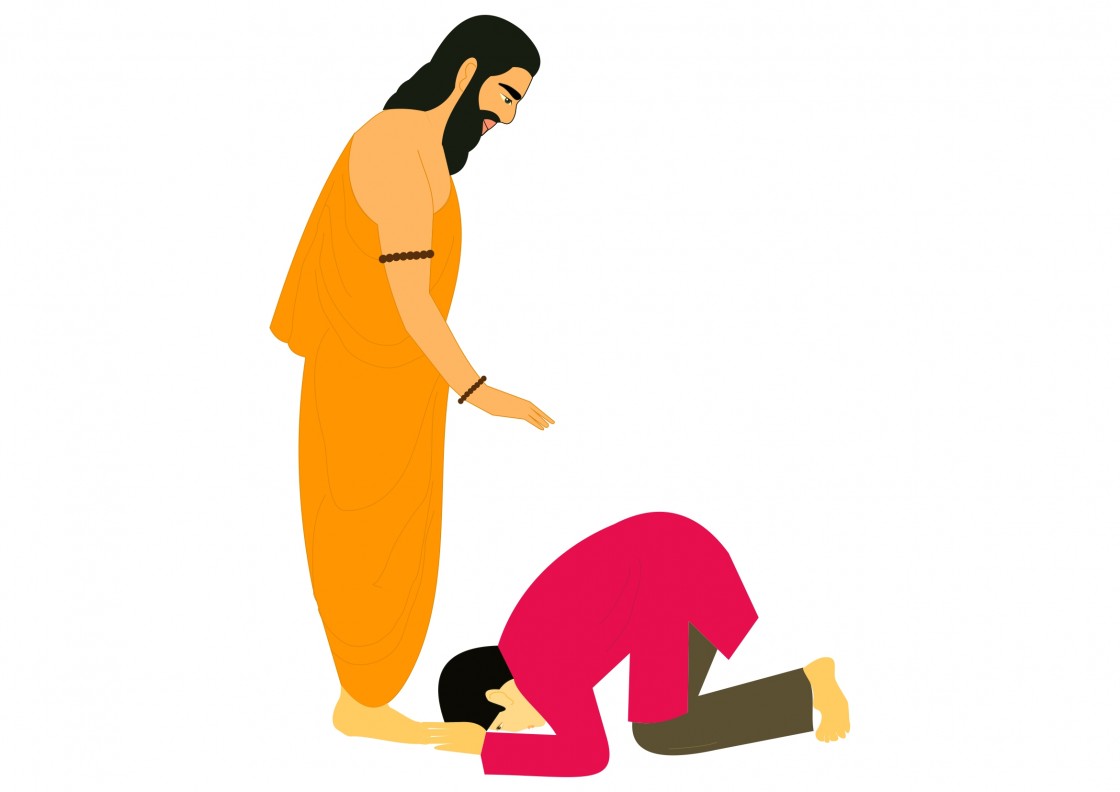
    From childhood, we are taught to bow before our elders, touch their feet, and seek their blessings. It is a tradition deeply rooted in our culture—a gesture of humility, gratitude, and respect. We are told that the blessings of elders carry divine grace, that they pave the way for prosperity and protect us from hardships.

    But over time, a question began to occupy my thoughts.

    Are blessings meaningful simply because they come from someone older? Or do blessings derive their strength from the life that person has lived?

    Age and wisdom are often mistaken for one another. Growing older is inevitable; growing wiser is a choice. Not every elder has walked a path worth following. Some lives are built on compassion, integrity, sacrifice, and selflessness. Others may be marked by dishonesty, arrogance, or selfish pursuits. If a person’s deeds have caused pain rather than hope, can their blessings truly be considered auspicious?

    Perhaps the power of a blessing lies not merely in spoken words but in the life behind those words.

    A blessing from someone who has stood for truth despite adversity carries a different weight. A blessing from a person who has spent their life uplifting others, choosing kindness over cruelty, and leaving the world a little better than they found it feels genuine. Their words are not empty rituals—they are an extension of the values they have lived by.

    After all, what is a blessing if not a silent wish that another person experiences the goodness you have cultivated within yourself?

    Respect for elders should never disappear. Every individual deserves dignity simply for being human. But reverence is something different from respect. Reverence is earned through character, not chronology. It is earned by actions that inspire others, by principles that withstand temptation, and by a life that becomes an example rather than merely a story.

    We often inherit traditions without questioning their essence. Yet traditions remain meaningful only when we understand the values they were created to preserve. The purpose of seeking blessings was never simply to acknowledge age—it was to seek guidance from those whose lives reflected wisdom.

    Perhaps we should seek blessings not because someone has lived longer, but because they have lived better.

    The footprints we choose to follow determine the destination we reach. Therefore, before seeking someone’s blessings, perhaps we should first ask ourselves a simpler question:

    Would I be proud to live the life they have lived?

    If the answer is yes, then their blessing is not just a tradition—it becomes a legacy passed from one life to another.

  • Book Review: A Time For Mercy

    Book Review: A Time For Mercy

    From the very first chapter, this book delivers a gripping courtroom drama that keeps the suspense alive until the very end. Every courtroom exchange, piece of evidence, and legal argument adds another layer of intrigue, making it difficult to predict how the story will unfold. The tension builds steadily, ensuring that readers remain invested throughout.

    What truly sets this novel apart is the way it explores the delicate balance between justice and mercy. Rather than presenting clear-cut answers, it challenges readers to think about the consequences of difficult choices and the moral complexities that often accompany the pursuit of justice. It raises questions that linger long after the final page, encouraging reflection on what is truly right and fair.

    The characters are exceptionally well-developed, each carrying emotional depth and personal struggles that make them feel genuine. Their motivations, relationships, and inner conflicts add authenticity to the story, making it easy to empathize with them even when their decisions are difficult to understand. These layered personalities elevate the novel beyond a typical legal thriller.

    The legal proceedings are both engaging and accessible. While the courtroom scenes are detailed enough to satisfy readers who enjoy legal fiction, they never become so technical that they slow the pace or overwhelm the narrative. Instead, the legal twists and strategic battles enhance the suspense, keeping the story fresh and unpredictable.

    The pacing deserves special mention. The novel moves at a consistent rhythm, balancing moments of intense courtroom drama with quieter scenes that deepen the characters and themes. There are very few dull moments, making it a book that’s genuinely difficult to put down once you’ve started.

    Overall, this is an intelligent, emotionally engaging legal thriller that combines suspense with meaningful themes. It’s more than just a courtroom battle—it’s a thought-provoking exploration of morality, responsibility, and the complexities of the justice system. Whether you’re a longtime fan of legal fiction or simply looking for a compelling, well-written novel, this book is well worth your time.

    Rating: 4.7/5 ⭐

  • We Are All Beggars… Only Our Needs Are Different

    We Are All Beggars… Only Our Needs Are Different

    The world is a strange place.

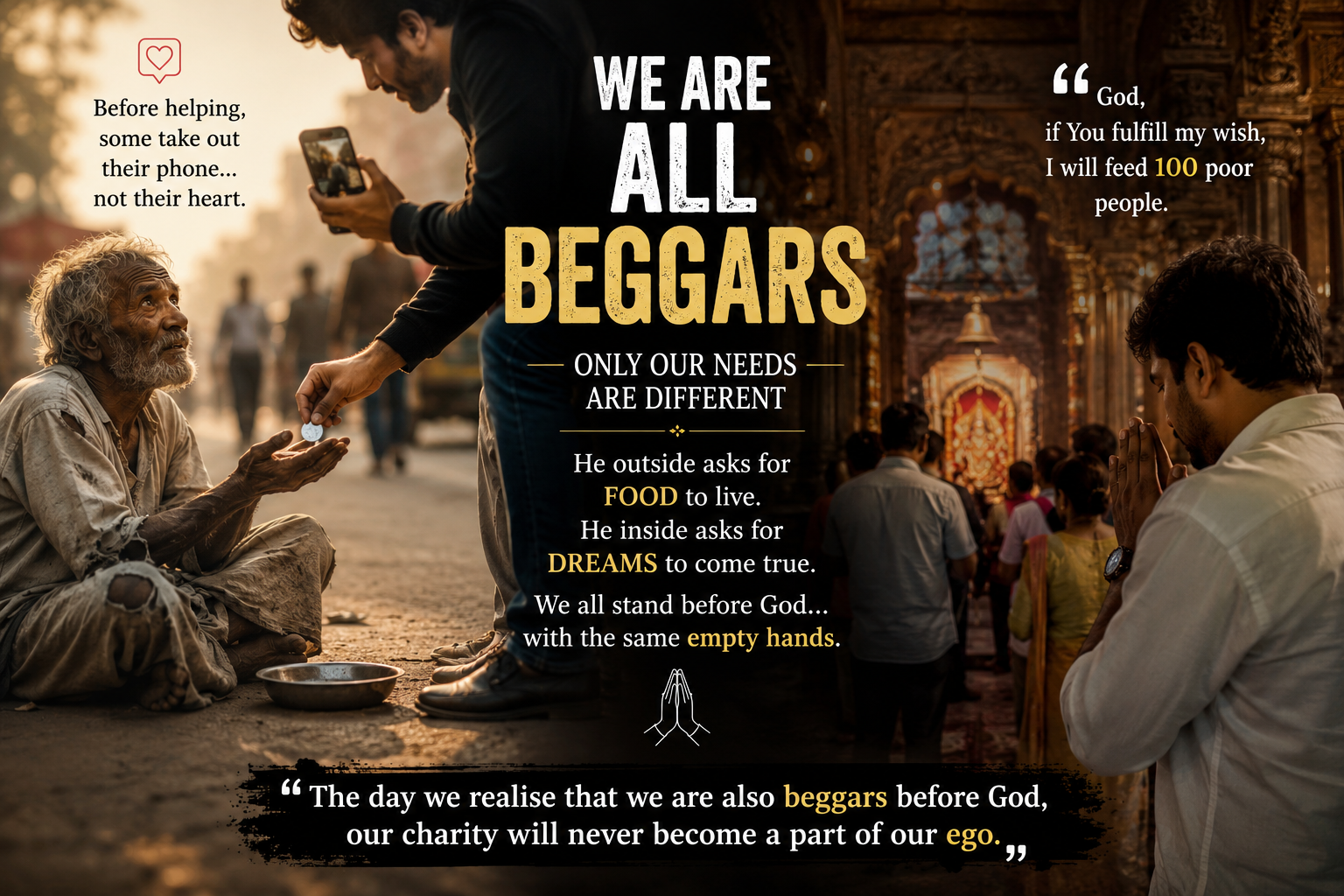
    A man who stretches out his hand and asks for help is labelled poor, helpless, and a beggar. But the one who offers him a few coins often begins to see himself as generous, righteous, and noble.

    And perhaps the saddest part is this…

    Before reaching into the pocket for money, many first reach for their phone.

    A video is recorded.

    A photograph is taken.

    Then it is uploaded to social media, where the real charity is often overshadowed by the hunger for likes, comments, and applause.

    If kindness needs an audience, can it still be called kindness?

    What is even more ironic is that while giving, many choose the smallest thing they can spare—a few coins, a packet of biscuits, or a handful of rice. Yet they present that tiny act as though they have sacrificed everything.

    But now, let us look at the other side of the picture.

    The very people who proudly considered themselves benefactors outside…

    Stand before God with folded hands inside the temple.

    “God, please make my business successful.”

    “Please bless my daughter’s marriage.”

    “Heal my mother’s illness.”

    “Help me get the job I desperately need.”

    “Take away the struggles from my life.”

    And then comes the promise…

    “Lord, if You fulfill my wish, I will feed one hundred poor people.”

    At that very moment, a question crossed my mind…

    Perhaps it crossed God’s mind too.

    “The one who stands before Me asking for blessings… how is he so proud to promise what belongs to Me? The one who is begging Me today is promising to feed others tomorrow.”

    That day I understood something I had never understood before.

    The man sitting outside the temple was not the only beggar.

    Every person standing inside was a beggar too.

    The only difference was what they were asking for.

    The man outside asked for bread.

    The man inside asked for wealth.

    The man outside prayed for clothes to cover his body.

    The man inside prayed for a profitable business deal.

    The man outside begged for another day to live.

    The man inside begged for his dreams to come true.

    And suddenly, everything became clear.

    We are all beggars.

    Only our needs are different.

    Some ask for food.

    Some ask for success.

    Some ask for love.

    Some ask for health.

    Some ask for peace.

    Some ask for another chance.

    If that is true…

    What exactly are we so proud of?

    Today we feel superior because we fed a hungry stranger.

    Tomorrow we stand before God asking Him to feed our own hopes, our own dreams, and our own fears.

    Helping someone is one of the most beautiful things a human being can do.

    But turning that help into a display of superiority…

    That is where humanity begins to lose its soul.

    God never asked us to make the world witness our charity.

    He simply taught us that when we give, our compassion should speak louder than our ego.

    Perhaps that is why every act of kindness is not a favour we do for someone else.

    It is an opportunity God gives us…

    To save the humanity within ourselves.

    In the end…

    There is no truly rich person.

    There is no truly poor person.

    No one is greater.

    No one is lesser.

    One day, every one of us will stand before the same Creator.

    With nothing in our hands.

    Exactly as we came into this world.

    Empty.


    Final Thought

    “The day we realise that we too stand before God with empty hands, our charity will no longer become a display of pride—it will become an act of gratitude, humility, and love. Because before the Creator, we are all seekers… only our prayers are different.”

  • The Digital Childhood Crisis: Are We Raising a Generation That Can’t Disconnect?

    The Digital Childhood Crisis: Are We Raising a Generation That Can’t Disconnect?

    The digital revolution has transformed the way we communicate, learn, and entertain ourselves. Smartphones and social media have connected the world in unimaginable ways, bringing knowledge to our fingertips and shrinking distances across continents. Yet, behind this technological marvel lies a growing crisis that society can no longer afford to ignore.

    The most vulnerable victims of this digital age are not adults—they are our children.

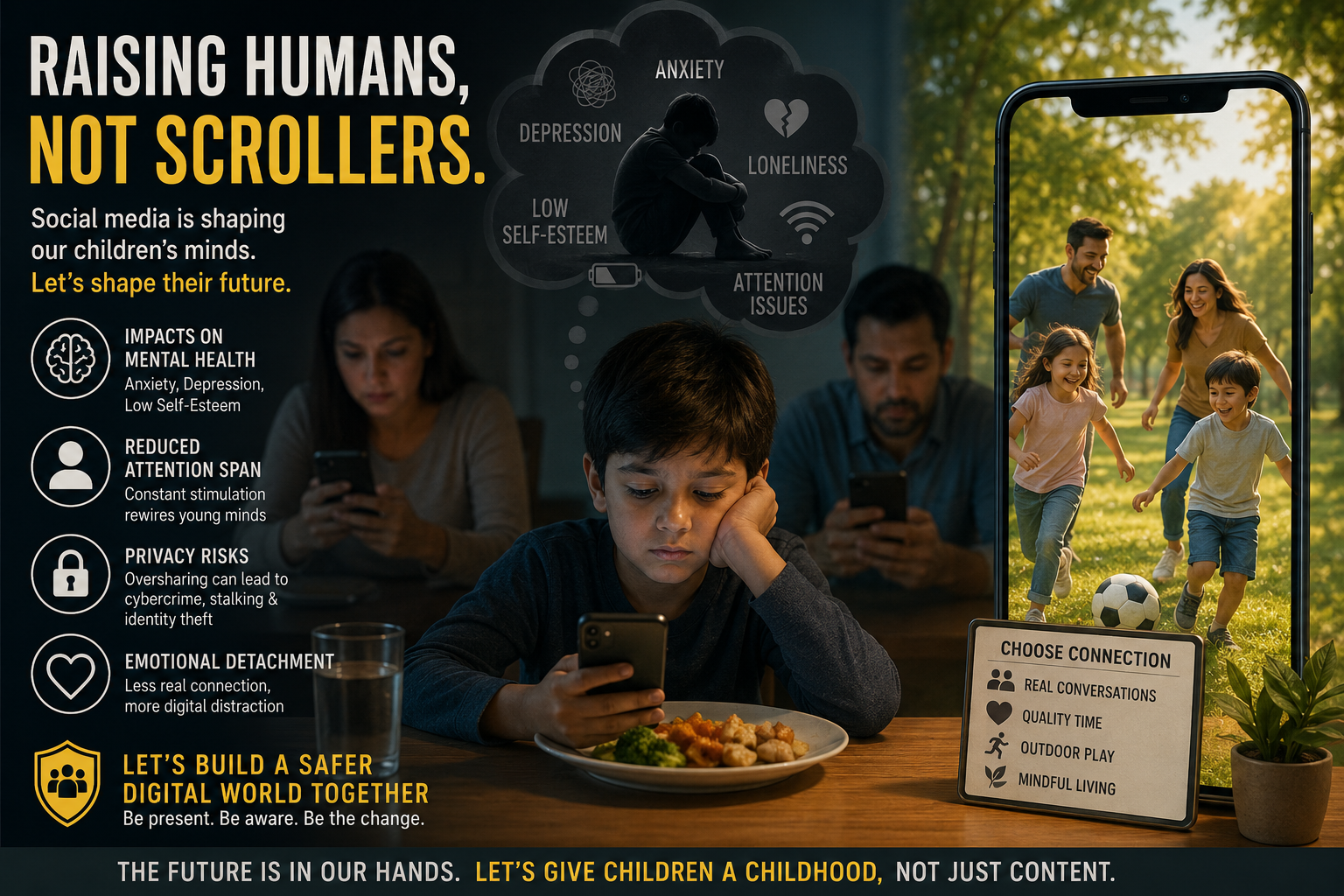
    A scene that has become increasingly common in households today is a child refusing to eat without a mobile phone in hand. Many parents consider it a convenient solution to keep their children occupied. However, this behaviour is far more than a parenting shortcut; it is an early warning sign of digital dependency. When a child cannot remain calm without constant digital stimulation, it raises a critical question: Are we nurturing healthy minds, or are we conditioning a generation to depend on screens for emotional regulation?

    Scientific research increasingly points towards excessive screen exposure as a contributing factor to reduced attention spans, sleep disturbances, anxiety, emotional dysregulation, and symptoms of depression among children and adolescents. The developing brain is highly sensitive to repeated dopamine-driven rewards—the very mechanism on which social media platforms and short-form video content are designed. Every swipe, notification, and “like” reinforces a cycle that encourages prolonged engagement, often at the expense of real-world experiences.

    Perhaps no feature represents this challenge better than the endless stream of short videos commonly known as reels. Designed using sophisticated algorithms powered by artificial intelligence, these platforms continuously deliver personalised content that keeps users scrolling for hours. While entertaining, this endless consumption gradually rewires attention, reduces patience for longer tasks, and creates a constant craving for instant gratification.

    Unfortunately, this problem extends far beyond children.

    Adults themselves have become deeply attached to their devices. Family dinners are interrupted by notifications. Conversations are replaced by scrolling. Vacations are experienced through camera lenses rather than with genuine presence. We are becoming digitally connected while emotionally disconnected.

    Even more concerning is the growing obsession with online validation.

    Social media has encouraged people to publicly display every aspect of their lives—from their homes and financial assets to intimate family moments. While sharing memories is natural, oversharing personal information exposes families to privacy risks, cybercrime, identity theft, stalking, and unnecessary public scrutiny. The desire for likes, followers, and viral recognition often overshadows concerns about digital safety.

    Perhaps the most troubling trend is the increasing involvement of children in content creation. Parents, driven by the pursuit of online popularity, frequently feature their children in reels and videos without fully understanding the long-term consequences. Childhood, once defined by privacy and innocence, is now increasingly documented for public consumption.

    What happens when the views decline?

    The psychological impact can be significant. For individuals whose self-worth becomes tied to online engagement, declining likes, comments, and followers may trigger anxiety, stress, emotional insecurity, and even depression. Children who grow up associating attention with personal value may struggle with identity, confidence, and emotional resilience later in life.

    Recognising these risks, several countries have begun introducing regulations aimed at protecting minors from excessive social media exposure through age restrictions, parental controls, and stronger digital safety policies. These initiatives acknowledge an important truth: unrestricted social media access is not merely a technological issue—it is a public health concern.

    Ironically, while the world is united in discussing climate change, pollution, and environmental sustainability, far less attention is given to digital pollution—the invisible yet profound impact excessive technology has on our minds, relationships, and society. Unlike environmental damage, the effects of digital overconsumption cannot always be seen immediately, but they gradually reshape behaviour, mental health, and social interactions.

    The solution is not to reject technology. Digital innovation has become an indispensable part of modern life. The challenge is to promote responsible usage rather than unrestricted consumption.

    Parents must model healthy digital habits before expecting them from their children. Schools should incorporate digital literacy and online wellbeing into their curricula. Governments should strengthen child protection laws for social media platforms. Technology companies must design products that prioritise user wellbeing alongside engagement metrics. Above all, families should reclaim screen-free moments—shared meals, conversations, outdoor activities, reading, and genuine human interaction.

    The future of our society will not be determined solely by how advanced our technology becomes, but by whether we can ensure that technology remains a tool rather than becoming our master.

    The greatest challenge of the 21st century may not be building smarter devices—it may be raising children who know when to put them down.

  • Stop Seeking Validation From People Who Haven’t Won Their Own Battles

    Stop Seeking Validation From People Who Haven’t Won Their Own Battles

    One of the biggest mistakes we make in life is seeking validation from people who are still struggling to validate themselves.

    Why should your dreams, decisions, or ambitions be judged by someone who hasn’t conquered their own fears? Why allow opinions from people who have never walked your path to dictate the direction of your life?

    The truth is simple: every journey is unique.

    No two people fight the same battles. No two people face identical obstacles. Even if someone has already achieved what you’re trying to accomplish, their route, timing, opportunities, sacrifices, and circumstances were entirely different from yours.

    Many people will tell you to simply copy the successful.

    What they fail to understand is that success isn’t a recipe—it’s a combination of preparation, courage, instinct, perseverance, and yes… luck.

    Luck is an uncomfortable word because it reminds us that not everything is within our control. Sometimes the right opportunity arrives at the right moment. Sometimes it doesn’t. But what remains in your control is your willingness to keep moving despite uncertainty.

    Your instincts matter.

    Your decisions matter.

    Your ability to adapt matters.

    And your failures matter even more.

    I’d rather fail a hundred times learning from my own decisions than spend my life living according to someone else’s blueprint. Every failure teaches something no book, mentor, or motivational speaker ever can. Experience builds wisdom. Borrowed opinions rarely do.

    The people who criticize you today are often people who have never dared to take the risks you’re taking. They measure your potential through the limits of their own lives.

    Don’t seek permission to become who you’re capable of becoming.

    Seek growth.

    Seek experience.

    Seek resilience.

    Validation is temporary.

    Character is permanent.

    At the end of the day, your life won’t be defined by how many people agreed with your decisions. It will be defined by the courage you had to make them when nobody else believed in you.

    Trust your journey. Trust your instincts. Learn from your failures. Let your results become your validation.

  • The Day You Realize Nobody Is Coming

    The Day You Realize Nobody Is Coming

    One of the saddest realizations in life is not that people hate you.

    It’s realizing that most people simply don’t care as much as you thought they did.

    We spend our lives surrounded by people. Family, friends, relatives, colleagues, acquaintances. Our phones are full of contacts. Our social media is filled with likes, comments, birthday wishes, and smiling faces.

    And somewhere in our hearts, we begin believing that all these people genuinely care about us.

    But do they?

    If tomorrow you disappeared from everyone’s life, how many would truly feel your absence?

    Not for a day.
    Not for a week.

    But deeply enough to leave a permanent emptiness in their hearts.

    The answer is often far smaller than we are willing to admit.

    The harsh truth about life is that everyone is the hero of their own story. While you are busy worrying about others, thinking about their happiness, helping them through their struggles, they are often busy doing the exact same thing for themselves.

    Most people don’t wake up thinking about you.

    They wake up thinking about their bills, their ambitions, their problems, their dreams, their families, their future.

    You are merely a passing chapter in a book where they are the main character.

    And there is nothing more painful than discovering that the people you would move mountains for wouldn’t even cross a street for you.

    Life teaches this lesson slowly.

    You call someone a friend until you need help.

    You call someone family until you need understanding.

    You call someone your own until circumstances test the relationship.

    And then suddenly, the crowd disappears.

    The phone becomes silent.

    The concern becomes formal.

    The affection becomes conditional.

    And the people you thought would stand beside you become distant spectators.

    At first it hurts.

    It hurts because you remember every time you showed up for them.

    Every late-night conversation.

    Every favor.

    Every sacrifice.

    Every moment you chose them over yourself.

    You expected that kindness to come back one day.

    But life doesn’t work on emotional investments.

    Many people will happily receive your loyalty without ever intending to return it.

    That realization changes a person.

    You stop explaining yourself.

    You stop expecting.

    You stop chasing.

    You stop begging people to understand your worth.

    Instead, you begin observing.

    Quietly.

    Patiently.

    You notice who remembers you only when they need something.

    You notice who vanishes during your storms.

    You notice who celebrates your success with genuine happiness and who secretly wishes you had achieved a little less.

    And slowly, without announcing it to anyone, you become different.

    Not colder.

    Just wiser.

    You begin understanding that genuine people are incredibly rare.

    Very few people truly care about your happiness.

    Very few people pray for your success when it doesn’t benefit them.

    Very few people stand beside you when there is nothing to gain.

    And those few?

    Hold onto them with all your heart.

    Because they are life’s greatest blessing.

    The world is full of performances.

    People perform friendship.

    People perform affection.

    People perform concern.

    People perform loyalty.

    But when life becomes difficult, the performance ends and reality takes the stage.

    That’s when you finally see people for who they are.

    And perhaps that is why silence is so powerful.

    Silence doesn’t expose you.

    Silence exposes everyone else.

    When you stop talking, people reveal their intentions.

    When you stop reaching out, people reveal their priorities.

    When you stop being available, people reveal how much they actually value your presence.

    The older I grow, the more I understand this simple truth:

    We enter this world alone.

    We leave this world alone.

    And somewhere in between, we spend years believing that more people are walking beside us than actually are.

    The day you accept this truth is painful.

    But it is also liberating.

    Because from that day onward, you stop seeking validation from crowds and start valuing the rare souls who genuinely care.

    And trust me, even if that number is only one or two people…

    You are richer than most.

  • Gratitude — The Forgotten Conversation with the Universe

    Gratitude — The Forgotten Conversation with the Universe

    Every day, we wake up with a list of desires.

    We ask for success. We ask for wealth. We ask for better health, better opportunities, better relationships, and a better life. We keep asking the universe for more, believing that happiness lies in the next achievement, the next possession, or the next milestone.

    But when was the last time we simply stopped and said, “Thank You”?

    When was the last time we paused long enough to appreciate how far we have come?

    Think about it for a moment.

    Many of the things you have today were once prayers whispered in silence. The job you wished for, the home you dreamed of, the people you hoped would stay by your side, the experiences you longed to live—many of them are already part of your life. Yet, in the race toward what is next, we often forget to cherish what is already ours.

    We become so focused on the destination that we fail to admire the distance we have travelled.

    A few years ago, you were a different person with different struggles, different fears, and different dreams. You have survived challenges you once thought would break you. You have grown, learned, healed, and evolved in ways you may not even fully realize.

    That deserves acknowledgment.

    The universe has always been working alongside you—not against you. Every lesson, every setback, every unexpected turn has shaped the person you are today. But a relationship built only on requests eventually becomes one-sided. Imagine a friend who only calls when they need something. How long would that connection feel meaningful?

    Gratitude changes everything.

    Gratitude shifts your focus from scarcity to abundance. It reminds you that your life is not defined by what is missing, but by what is already present. It allows you to see blessings where you once saw ordinary moments.

    The universe responds not only to our desires but also to our appreciation. Gratitude is a form of energy. It opens our eyes to the miracles we have been overlooking and creates space for even greater blessings to enter our lives.

    So today, before you sleep, take a few quiet moments for yourself.

    Put aside the worries. Put aside the wishes.

    Look around and count the things that are already beautiful in your life—your health, your family, your friends, your experiences, your lessons, your resilience, and your journey.

    Offer a sincere prayer of gratitude to the universe.

    Not for what you hope to receive tomorrow, but for everything you have already been given today.

    Because sometimes the greatest transformation begins not when we ask for more, but when we finally learn to appreciate enough.

    And perhaps that is where true abundance begins.