The digital revolution has transformed the way we communicate, learn, and entertain ourselves. Smartphones and social media have connected the world in unimaginable ways, bringing knowledge to our fingertips and shrinking distances across continents. Yet, behind this technological marvel lies a growing crisis that society can no longer afford to ignore.
The most vulnerable victims of this digital age are not adults—they are our children.
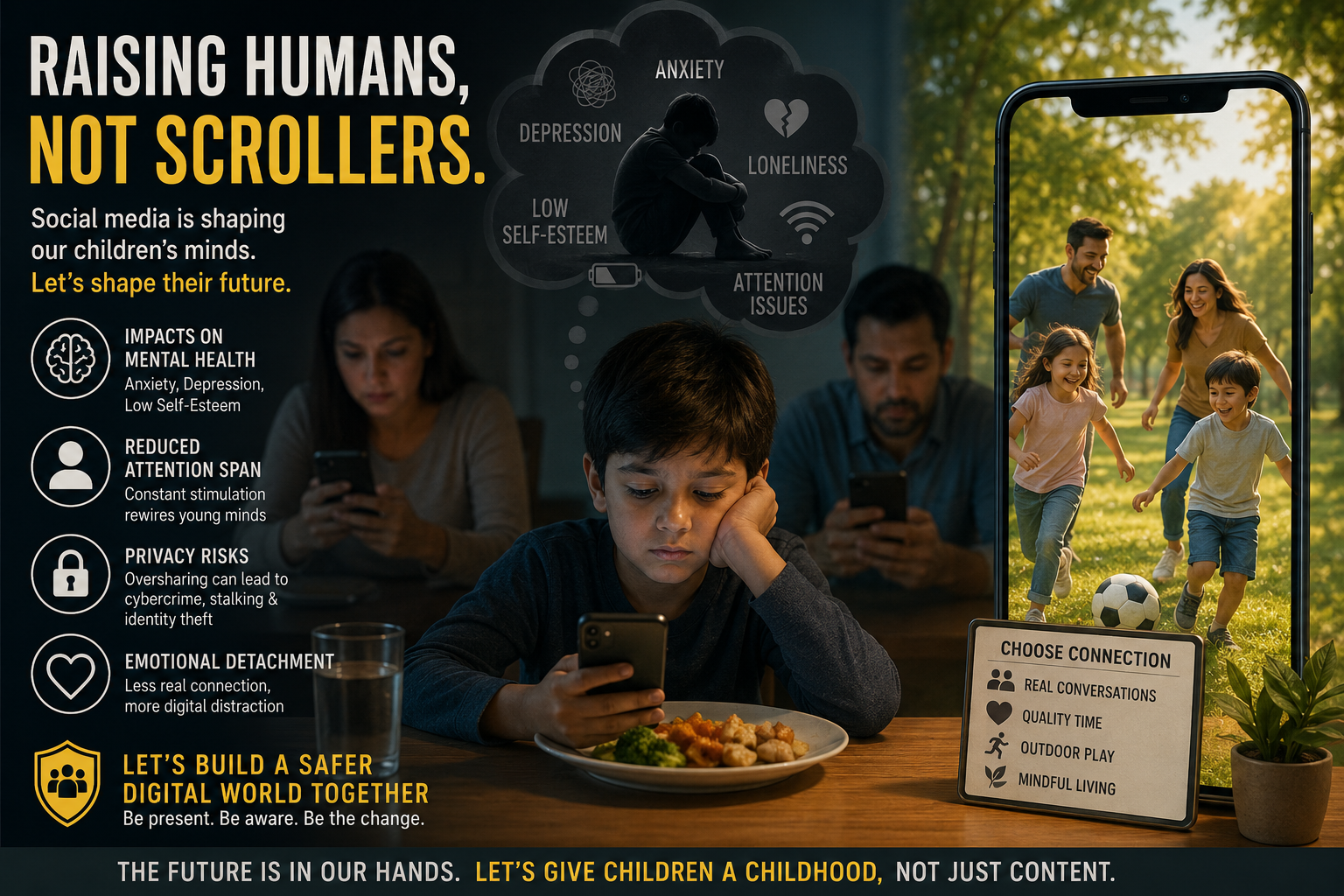
A scene that has become increasingly common in households today is a child refusing to eat without a mobile phone in hand. Many parents consider it a convenient solution to keep their children occupied. However, this behaviour is far more than a parenting shortcut; it is an early warning sign of digital dependency. When a child cannot remain calm without constant digital stimulation, it raises a critical question: Are we nurturing healthy minds, or are we conditioning a generation to depend on screens for emotional regulation?
Scientific research increasingly points towards excessive screen exposure as a contributing factor to reduced attention spans, sleep disturbances, anxiety, emotional dysregulation, and symptoms of depression among children and adolescents. The developing brain is highly sensitive to repeated dopamine-driven rewards—the very mechanism on which social media platforms and short-form video content are designed. Every swipe, notification, and “like” reinforces a cycle that encourages prolonged engagement, often at the expense of real-world experiences.
Perhaps no feature represents this challenge better than the endless stream of short videos commonly known as reels. Designed using sophisticated algorithms powered by artificial intelligence, these platforms continuously deliver personalised content that keeps users scrolling for hours. While entertaining, this endless consumption gradually rewires attention, reduces patience for longer tasks, and creates a constant craving for instant gratification.
Unfortunately, this problem extends far beyond children.
Adults themselves have become deeply attached to their devices. Family dinners are interrupted by notifications. Conversations are replaced by scrolling. Vacations are experienced through camera lenses rather than with genuine presence. We are becoming digitally connected while emotionally disconnected.
Even more concerning is the growing obsession with online validation.
Social media has encouraged people to publicly display every aspect of their lives—from their homes and financial assets to intimate family moments. While sharing memories is natural, oversharing personal information exposes families to privacy risks, cybercrime, identity theft, stalking, and unnecessary public scrutiny. The desire for likes, followers, and viral recognition often overshadows concerns about digital safety.
Perhaps the most troubling trend is the increasing involvement of children in content creation. Parents, driven by the pursuit of online popularity, frequently feature their children in reels and videos without fully understanding the long-term consequences. Childhood, once defined by privacy and innocence, is now increasingly documented for public consumption.
What happens when the views decline?
The psychological impact can be significant. For individuals whose self-worth becomes tied to online engagement, declining likes, comments, and followers may trigger anxiety, stress, emotional insecurity, and even depression. Children who grow up associating attention with personal value may struggle with identity, confidence, and emotional resilience later in life.
Recognising these risks, several countries have begun introducing regulations aimed at protecting minors from excessive social media exposure through age restrictions, parental controls, and stronger digital safety policies. These initiatives acknowledge an important truth: unrestricted social media access is not merely a technological issue—it is a public health concern.
Ironically, while the world is united in discussing climate change, pollution, and environmental sustainability, far less attention is given to digital pollution—the invisible yet profound impact excessive technology has on our minds, relationships, and society. Unlike environmental damage, the effects of digital overconsumption cannot always be seen immediately, but they gradually reshape behaviour, mental health, and social interactions.
The solution is not to reject technology. Digital innovation has become an indispensable part of modern life. The challenge is to promote responsible usage rather than unrestricted consumption.
Parents must model healthy digital habits before expecting them from their children. Schools should incorporate digital literacy and online wellbeing into their curricula. Governments should strengthen child protection laws for social media platforms. Technology companies must design products that prioritise user wellbeing alongside engagement metrics. Above all, families should reclaim screen-free moments—shared meals, conversations, outdoor activities, reading, and genuine human interaction.
The future of our society will not be determined solely by how advanced our technology becomes, but by whether we can ensure that technology remains a tool rather than becoming our master.
The greatest challenge of the 21st century may not be building smarter devices—it may be raising children who know when to put them down.