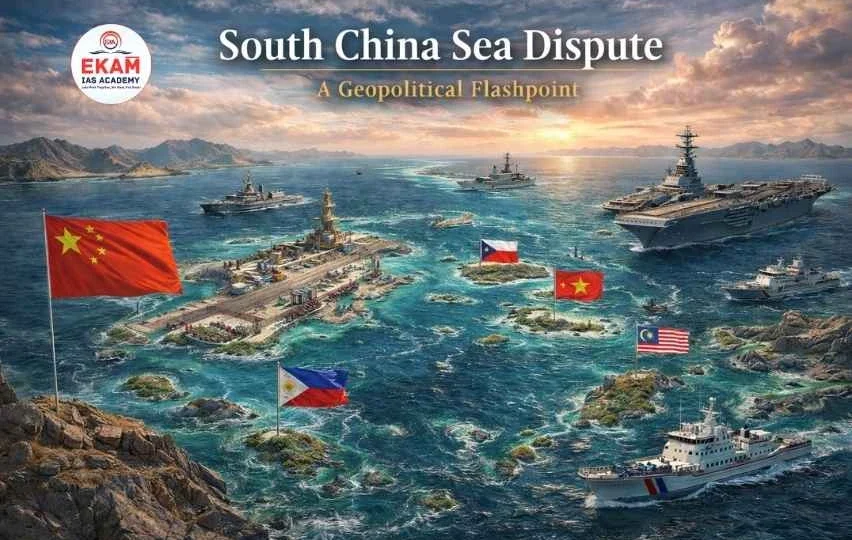
When people hear about the South China Sea, the headlines often reduce the story to another confrontation between China and the Philippines. While that is currently the most visible flashpoint, the dispute is far more intricate. It is a convergence of international law, maritime strategy, economic security, military deterrence, and great-power competition.
A Dispute Rooted in Competing Claims
China asserts historical rights over a vast portion of the South China Sea through what is commonly referred to as the “Nine-Dash Line.” The Philippines, however, maintains that many of the contested waters and maritime features fall within its 200-nautical-mile Exclusive Economic Zone (EEZ), as defined under the United Nations Convention on the Law of the Sea (UNCLOS).
In 2016, an international arbitral tribunal ruled that China’s historic claims, as represented by the Nine-Dash Line, have no legal basis under UNCLOS. Beijing rejected the ruling, arguing that the tribunal lacked jurisdiction and continues to assert its claims. This legal disagreement remains one of the central reasons why tensions persist.
Why the South China Sea Matters
The South China Sea is among the world’s most strategically valuable maritime regions.
Approximately one-third of global maritime trade transits these waters each year. It serves as a crucial route for energy imports, manufactured goods, and raw materials connecting East Asia with Europe, the Middle East, and beyond. Any instability in this corridor has the potential to disrupt global supply chains, increase freight costs, influence energy prices, and create wider economic uncertainty.
Beyond commerce, the region is believed to contain substantial reserves of hydrocarbons and supports one of the world’s richest fishing grounds, making it economically significant for all claimant states.
The United States and the Strategic Equation
The United States is not a claimant in the territorial dispute, yet it plays a pivotal strategic role.
Washington maintains a Mutual Defense Treaty with the Philippines dating back to 1951. In recent years, U.S. officials have reiterated that an armed attack on Philippine armed forces, vessels, or aircraft operating in the Pacific, including the South China Sea, could trigger treaty obligations.
This does not mean every confrontation will automatically result in military intervention. However, it significantly raises the geopolitical stakes, as even a localized incident could rapidly involve larger powers.
China’s Strategic Imperative
For China, the South China Sea extends well beyond economic interests.
The region provides vital sea lines of communication through which much of China’s energy imports and international trade pass. It also forms an important component of Beijing’s maritime security strategy, allowing it greater operational depth for its naval forces and enhancing its influence throughout the Indo-Pacific.
From Beijing’s perspective, maintaining a strong presence in these waters is closely tied to national security and long-term strategic interests.
Taiwan: A Parallel Strategic Theatre
Although Taiwan is geographically distinct from the South China Sea dispute, the two issues are increasingly interconnected within broader Indo-Pacific security dynamics.
Taiwan is home to the world’s most advanced semiconductor manufacturing ecosystem. Companies based there produce a substantial share of the cutting-edge chips powering smartphones, artificial intelligence systems, data centers, automobiles, and defense technologies.
Any major regional conflict—whether in the Taiwan Strait or the South China Sea—would likely have profound consequences for the global technology industry and international markets.
Looking Ahead
The South China Sea represents far more than competing territorial claims.
It is a contest over maritime law, strategic influence, military deterrence, economic security, and the future architecture of the Indo-Pacific region.
The challenge for all stakeholders will be preventing tactical confrontations at sea from escalating into strategic crises. Diplomacy, adherence to international law, and effective crisis-management mechanisms remain essential to ensuring that one of the world’s busiest maritime corridors does not become the epicenter of a wider geopolitical conflict.
As tensions continue to evolve, the South China Sea will remain one of the defining geopolitical stories of the twenty-first century—not simply because of the waters themselves, but because of what they represent in the emerging global order.
Leave a Reply